 |
LLGL 0.05 Beta
|
Loading...
Searching...
No Matches
|
LLGL 0.05 Beta
|
Command buffer interface used for storing and encoding GPU commands. More...
#include <CommandBuffer.h>
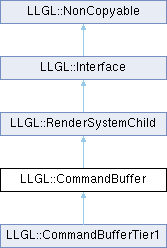
Public Member Functions | |
| virtual void | Begin ()=0 |
| Begins with the encoding (also referred to as "recording") of this command buffer. | |
| virtual void | End ()=0 |
| Ends the encoding (also referred to as "recording") of this command buffer. | |
| virtual void | Execute (CommandBuffer &secondaryCommandBuffer)=0 |
| Executes the specified secondary command buffer by inlining its commands into this command buffer. | |
| virtual void | UpdateBuffer (Buffer &dstBuffer, std::uint64_t dstOffset, const void *data, std::uint64_t dataSize)=0 |
| Updates the data of the specified buffer during encoding the command buffer. | |
| virtual void | CopyBuffer (Buffer &dstBuffer, std::uint64_t dstOffset, Buffer &srcBuffer, std::uint64_t srcOffset, std::uint64_t size)=0 |
| Encodes a buffer copy command for the specified buffer region. | |
| virtual void | CopyBufferFromTexture (Buffer &dstBuffer, std::uint64_t dstOffset, Texture &srcTexture, const TextureRegion &srcRegion, std::uint32_t rowStride=0, std::uint32_t layerStride=0)=0 |
| Encodes a buffer copy command that blits data from a source texture. | |
| virtual void | FillBuffer (Buffer &dstBuffer, std::uint64_t dstOffset, std::uint32_t value, std::uint64_t fillSize=LLGL_WHOLE_SIZE)=0 |
| Fills the destination buffer with copies of the specified 32-bit value. | |
| virtual void | CopyTexture (Texture &dstTexture, const TextureLocation &dstLocation, Texture &srcTexture, const TextureLocation &srcLocation, const Extent3D &extent)=0 |
| Encodes a texture copy command for the specified texture regions. | |
| virtual void | CopyTextureFromBuffer (Texture &dstTexture, const TextureRegion &dstRegion, Buffer &srcBuffer, std::uint64_t srcOffset, std::uint32_t rowStride=0, std::uint32_t layerStride=0)=0 |
| Encodes a texture copy command that blits data from a source buffer. | |
| virtual void | CopyTextureFromFramebuffer (Texture &dstTexture, const TextureRegion &dstRegion, const Offset2D &srcOffset)=0 |
| Encodes a texture copy command that blits data from the current framebuffer. | |
| virtual void | GenerateMips (Texture &texture)=0 |
| Generates all MIP-maps for the specified texture. | |
| virtual void | GenerateMips (Texture &texture, const TextureSubresource &subresource)=0 |
| Generates a range of MIP-maps for the specified texture. | |
| virtual void | SetViewport (const Viewport &viewport)=0 |
| Sets a single viewport. | |
| virtual void | SetViewports (std::uint32_t numViewports, const Viewport *viewports)=0 |
| Sets an array of viewports. | |
| virtual void | SetScissor (const Scissor &scissor)=0 |
| Sets a single scissor rectangle. | |
| virtual void | SetScissors (std::uint32_t numScissors, const Scissor *scissors)=0 |
| Sets an array of scissor rectangles, but only if the scissor test was enabled in the previously set graphics pipeline (otherwise, this function has no effect). | |
| virtual void | SetVertexBuffer (Buffer &buffer)=0 |
| Sets the specified vertex buffer for subsequent drawing operations. | |
| virtual void | SetVertexBuffer (Buffer &buffer, std::uint32_t stride, std::uint64_t offset=0)=0 |
| Sets the specified vertex buffer for subsequent drawing operations with a new stride and optional base offset. | |
| virtual void | SetVertexBuffers (std::uint32_t numBufferViews, const VertexBufferView *bufferViews)=0 |
| Sets the specified number of vertex buffers for subsequent drawing operations with optional strides and base offsets. | |
| virtual void | SetVertexBufferArray (BufferArray &bufferArray)=0 |
| Sets the specified array of vertex buffers for subsequent drawing operations. | |
| virtual void | SetIndexBuffer (Buffer &buffer)=0 |
| Sets the active index buffer for subsequent drawing operations. | |
| virtual void | SetIndexBuffer (Buffer &buffer, const Format format, std::uint64_t offset=0)=0 |
| Sets the active index buffer for subsequent drawing operations with a dynamic format and optional buffer offset. | |
| virtual void | SetResourceHeap (ResourceHeap &resourceHeap, std::uint32_t descriptorSet=0)=0 |
| Binds the specified resource heap to the respective pipeline. | |
| virtual void | SetResource (std::uint32_t descriptor, Resource &resource)=0 |
| Binds the specified resource as root parameter to the respective pipeline. | |
| virtual void | ResourceBarrier (std::uint32_t numBuffers, Buffer *const *buffers, std::uint32_t numTextures, Texture *const *textures)=0 |
| Inserts a resource memory barrier for the specified resources. | |
| virtual void | BeginRenderPass (RenderTarget &renderTarget, const RenderPass *renderPass=nullptr, std::uint32_t numClearValues=0, const ClearValue *clearValues=nullptr, std::uint32_t swapBufferIndex=LLGL_CURRENT_SWAP_INDEX)=0 |
| Begins with a new render pass. | |
| virtual void | EndRenderPass ()=0 |
| Ends the current render pass. | |
| virtual void | Clear (long flags, const ClearValue &clearValue={})=0 |
| Clears the specified group of attachments of the active render target. | |
| virtual void | ClearAttachments (std::uint32_t numAttachments, const AttachmentClear *attachments)=0 |
| Clears the specified attachments of the active render target. | |
| virtual void | SetPipelineState (PipelineState &pipelineState)=0 |
| Sets the active graphics or compute pipeline state. | |
| virtual void | SetBlendFactor (const float color[4])=0 |
| Sets the dynamic pipeline state for blending factors. | |
| virtual void | SetStencilReference (std::uint32_t reference, const StencilFace stencilFace=StencilFace::FrontAndBack)=0 |
| Sets the dynamic pipeline state for stencil reference values. | |
| virtual void | SetUniforms (std::uint32_t first, const void *data, std::uint16_t dataSize)=0 |
| Sets the value of a certain number of shader uniforms (aka. push constant/ shader constants) in the currently bound PSO. | |
| virtual void | BeginQuery (QueryHeap &queryHeap, std::uint32_t query=0)=0 |
| Begins a query of the specified query heap. | |
| virtual void | EndQuery (QueryHeap &queryHeap, std::uint32_t query=0)=0 |
| Ends the specified query. | |
| virtual void | BeginRenderCondition (QueryHeap &queryHeap, std::uint32_t query=0, const RenderConditionMode mode=RenderConditionMode::Wait)=0 |
| Begins conditional rendering with the specified query object. | |
| virtual void | EndRenderCondition ()=0 |
| Ends the current render condition. | |
| virtual void | BeginStreamOutput (std::uint32_t numBuffers, Buffer *const *buffers)=0 |
| Begins a stream-output section for subsequent draw calls. | |
| virtual void | EndStreamOutput ()=0 |
| Ends the current stream-output. | |
| virtual void | Draw (std::uint32_t numVertices, std::uint32_t firstVertex)=0 |
| Draws the specified amount of primitives from the currently set vertex buffer. | |
| virtual void | DrawIndexed (std::uint32_t numIndices, std::uint32_t firstIndex)=0 |
| virtual void | DrawIndexed (std::uint32_t numIndices, std::uint32_t firstIndex, std::int32_t vertexOffset)=0 |
| Draws the specified amount of primitives from the currently set vertex- and index buffers. | |
| virtual void | DrawInstanced (std::uint32_t numVertices, std::uint32_t firstVertex, std::uint32_t numInstances)=0 |
| virtual void | DrawInstanced (std::uint32_t numVertices, std::uint32_t firstVertex, std::uint32_t numInstances, std::uint32_t firstInstance)=0 |
| Draws the specified amount of instances of primitives from the currently set vertex buffer. | |
| virtual void | DrawIndexedInstanced (std::uint32_t numIndices, std::uint32_t numInstances, std::uint32_t firstIndex)=0 |
| virtual void | DrawIndexedInstanced (std::uint32_t numIndices, std::uint32_t numInstances, std::uint32_t firstIndex, std::int32_t vertexOffset)=0 |
| virtual void | DrawIndexedInstanced (std::uint32_t numIndices, std::uint32_t numInstances, std::uint32_t firstIndex, std::int32_t vertexOffset, std::uint32_t firstInstance)=0 |
| Draws the specified amount of instances of primitives from the currently set vertex- and index buffers. | |
| virtual void | DrawIndirect (Buffer &buffer, std::uint64_t offset)=0 |
| Draws an unknown amount of instances of primitives whose draw command arguments are taken from a buffer object. | |
| virtual void | DrawIndirect (Buffer &buffer, std::uint64_t offset, std::uint32_t numCommands, std::uint32_t stride)=0 |
| Draws an unknown amount of instances of primitives whose draw command arguments are taken from a buffer object. | |
| virtual void | DrawIndexedIndirect (Buffer &buffer, std::uint64_t offset)=0 |
| Draws an unknown amount of instances of primitives whose indexed draw command arguments are taken from a buffer object. | |
| virtual void | DrawIndexedIndirect (Buffer &buffer, std::uint64_t offset, std::uint32_t numCommands, std::uint32_t stride)=0 |
| Draws an unknown amount of instances of primitives whose indexed draw command arguments are taken from a buffer object. | |
| virtual void | DrawStreamOutput ()=0 |
| Performs an automatic draw command whose number of primitives is provided by a stream-output buffer that is bound as vertex buffer. | |
| virtual void | Dispatch (std::uint32_t numWorkGroupsX, std::uint32_t numWorkGroupsY, std::uint32_t numWorkGroupsZ)=0 |
| Dispatches a compute command. | |
| virtual void | DispatchIndirect (Buffer &buffer, std::uint64_t offset)=0 |
| Dispatches a compute command with an unknown amount of thread grounds. | |
| virtual void | PushDebugGroup (const char *name)=0 |
| Pushes the specified name onto a stack of group strings that is used for debug reports. | |
| virtual void | PopDebugGroup ()=0 |
| virtual void | DoNativeCommand (const void *nativeCommand, std::size_t nativeCommandSize)=0 |
| Performs a native command that is backend specific. | |
| virtual bool | GetNativeHandle (void *nativeHandle, std::size_t nativeHandleSize)=0 |
| Returns the native command buffer handle. | |
| Public Member Functions inherited from LLGL::RenderSystemChild | |
| virtual void | SetDebugName (const char *name) |
| Sets the name of this class instance for debugging purposes. | |
| Public Member Functions inherited from LLGL::Interface | |
| virtual bool | IsInstanceOf (int id) const |
| Returns true if this object is an instance of the specified interface. | |
| Public Member Functions inherited from LLGL::NonCopyable | |
| NonCopyable (const NonCopyable &)=delete | |
| NonCopyable & | operator= (const NonCopyable &)=delete |
| virtual | ~NonCopyable ()=default |
Protected Member Functions | |
| CommandBuffer ()=default | |
| Protected Member Functions inherited from LLGL::NonCopyable | |
| NonCopyable ()=default | |
Command buffer interface used for storing and encoding GPU commands.
|
protecteddefault |
|
pure virtual |
Begins with the encoding (also referred to as "recording") of this command buffer.
Begin and End. This function also resets all previously encoded commands.
|
pure virtual |
Begins a query of the specified query heap.
| [in] | queryHeap | Specifies the query heap. |
| [in] | query | Specifies the zero-based index of the query within the heap to begin with. By default 0. This must be in the half-open range [0, QueryHeapDescriptor::numQueries). |
BeginQuery and EndQuery functions can be wrapped around any drawing and/or compute operation. This can be an occlusion query for instance, which determines how many fragments have passed the depth test. The result of a query can be retrieved by the command queue after this command buffer has been submitted.
|
pure virtual |
Begins conditional rendering with the specified query object.
| [in] | queryHeap | Specifies the query heap. This query heap must have been created with the renderCondition member set to true. |
| [in] | query | Specifies the zero-based index of the query within the heap which is to be used as render condition. By default 0. This must be in the half-open range [0, QueryHeapDescriptor::numQueries). |
| [in] | mode | Specifies the mode of the render condition. |
|
pure virtual |
Begins with a new render pass.
| [in] | renderTarget | Specifies the render target in which the subsequent draw operations will be stored. If this is a swap-chain and SwapChain::Present is called on such swap-chain before this command buffer is submitted to the command queue, use swapBufferIndex parameter to render into a specific swap buffer and then select the correct command buffer via SwapChain::GetCurrentSwapIndex when submitting to the command queue. |
| [in] | renderPass | Specifies an optional render pass object. If this is null, the default render pass for the specified render target will be used. This render pass object must be compatible with the render pass object the specified render target was created with. Note that the default render pass will ignore the previous framebuffer content (see AttachmentLoadOp::Undefined), i.e. such a render pass section should fill the entire framebuffer. |
| [in] | numClearValues | Specifies the number of clear values that are specified in the clearValues parameter. This should be greater than or equal to the number of render pass attachments whose load operation (i.e. AttachmentFormatDescriptor::loadOp) is set to AttachmentLoadOp::Clear. Otherwise, the following default values are used: (0, 0, 0, 0) for color, 1 for depth, 0 for stencil. |
| [in] | clearValues | Optional pointer to the array of clear values. If numClearValues is not zero, this must be a valid pointer to an array of at least numClearValues entries. Each entry in the array is used to clear the attachment whose load operation is set to AttachmentLoadOp::Clear, where the depth attachment (i.e. RenderPassDescriptor::depthAttachment) and the stencil attachment (i.e. RenderPassDescriptor::stencilAttachment) are combined and appear as the last entry. |
| [in] | swapBufferIndex | Optional index into what swap-chain buffer the render pass is meant to be rendered. If this is equal to LLGL_CURRENT_SWAP_INDEX, the current buffer in the swap-chain is used. Otherwise, this should be the current value returned from SwapChain::GetCurrentSwapIndex by the time this command buffer is submitted to the command queue. This parameter is ignored for regular render targets, i.e. if renderTarget is not a SwapChain. |
EndRenderPass function. Render passes must not be interleaved, i.e. each render pass must end before a new render pass can begin.Draw, DrawInstanced, DrawIndexed, DrawIndexedInstanced, DrawIndirect and DrawIndexedIndirect).Clear and ClearAttachments).BeginQuery and EndQuery).BeginRenderCondition and EndRenderCondition).BeginStreamOutput and EndStreamOutput).Dispatch and DispatchIndirect).UpdateBuffer, CopyBuffer*, and CopyTexture*).GenerateMips).
|
pure virtual |
Begins a stream-output section for subsequent draw calls.
| [in] | numBuffers | Specifies the number of stream-output buffers. This must be in the range [1, RenderingLimits::maxStreamOutputs]. |
| [in] | buffers | Array to the stream-output buffers. This must be a valid pointer to an array of numBuffers buffer objects. Each of these buffers must have been created with the binding flag BindFlags::StreamOutputBuffer. |
EndStreamOutput function. Stream outputs must not be interleaved, i.e. each stream output must end before a new stream output can begin.
|
pure virtual |
Clears the specified group of attachments of the active render target.
| [in] | flags | Specifies the clear buffer flags. This can be a bitwise OR combination of the ClearFlags enumeration entries. If this contains the ClearFlags::Color bit, all color attachments of the active render target are cleared with the color specified by clearValue. |
| [in] | clearValue | Specifies the value to which the attachments will be cleared. |
SetClear... function. To clear only a specific render-target color buffer, use the ClearAttachments function. Clearing a depth-stencil attachment while the active render target has no depth-stencil buffer is allowed but has no effect. For efficiency reasons, it is recommended to clear the render target attachments when a new render pass begins, i.e. the clear values of the BeginRenderPass function should be preferred over this function. For some render systems (e.g. Metal) this function forces the current render pass to stop and start again in order to clear the attachments.
|
pure virtual |
Clears the specified attachments of the active render target.
| [in] | numAttachments | Specifies the number of attachments to clear. |
| [in] | attachments | Pointer to the array of attachment clear commands. This must not be null! |
Clear function. Clearing a depth-stencil attachment while the active render target has no depth-stencil buffer is allowed but has no effect. For efficiency reasons, it is recommended to clear the render target attachments when a new render pass begins, i.e. the clear values of the BeginRenderPass function should be preferred over this function. For some render systems (e.g. Metal) this function forces the current render pass to stop and start again in order to clear the attachments.
|
pure virtual |
Encodes a buffer copy command for the specified buffer region.
| [in,out] | dstBuffer | Specifies the destination buffer whose data is to be updated. |
| [in] | dstOffset | Specifies the destination offset (in bytes) at which the destination buffer is to be updated. This offset plus the size (i.e. dstOffset + size) must be less than or equal to the size of the destination buffer. |
| [in] | srcBuffer | Specifies the source buffer whose data is to be read from. |
| [in] | srcOffset | Specifies the source offset (in bytes) at which the source buffer is to be read from. This offset plus the size (i.e. srcOffset + size) must be less than or equal to the size of the source buffer. |
| [in] | size | Specifies the size of the buffer region to copy. |
|
pure virtual |
Encodes a buffer copy command that blits data from a source texture.
| [in,out] | dstBuffer | Specifies the destination buffer whose data is to be updated. This buffer must have been created with the binding flag BindFlags::CopyDst. |
| [in] | dstOffset | Specifies the destination offset (in bytes) at which the source buffer is to be updated. This must be a multiple of 4. |
| [in] | srcTexture | Specifies the source texture whose data is to be read from. This texture must have been created with the binding flag BindFlags::CopySrc and its format must not be compressed (see FormatFlags::IsCompressed) or packed (see FormatFlags::IsPacked). |
| [in] | srcRegion | Specifies the source region where the texture is to be read from. Note that the numMipLevels attribute of this parameter must be 1. |
| [in] | rowStride | Specifies an optional stride (in bytes) per row in the destination buffer. By default 0. |
| [in] | layerStride | Specifies an optional stride (in bytes) per layer in the destination buffer. This must be a multiple of rowStride. If rowStride is zero, then layerStride must also be zero. By default 0. |
buffer := texture, or memcpy(destination, source, size).rowStride is not aligned to the respective rendering API restrictions:rowStride should be a multiple of 256.rowStride should be less than or equal to 32767 multiplied by the source texture's format size.rowStride is 0, the source data is considered to be tightly packed for each array layer and the required alignment is managed automatically. rowStride is not 0, it must be greater than or equal to the size (in bytes) of each row in the texture region with respect to the texture's format. rowStride also apply to layerStride.
|
pure virtual |
Encodes a texture copy command for the specified texture regions.
| [in,out] | dstTexture | Specifies the destination texture whose data is to be updated. |
| [in] | dstLocation | Specifies the destination location, including MIP-map level and offset. Its offset plus the extent (i.e. dstLocation.offset + extent) must be less than or equal to the size of the destination texture. |
| [in] | srcTexture | Specifies the source texture whose data is to be read from. |
| [in] | srcLocation | Specifies the source location, including MIP-map level and offset. Its offset plus the extent (i.e. srcLocation.offset + extent) must be less than or equal to the size of the source texture. |
| [in] | extent | Specifies the extent of the texture region to copy (see TextureDescriptor::extent). For this function, the extent also includes the array layers, i.e. y component for 1D arrays (TextureType::Texture1DArray), and z component for 2D and cube arrays (TextureType::Texture2DArray and TextureType::TextureCubeArray). |
|
pure virtual |
Encodes a texture copy command that blits data from a source buffer.
| [in,out] | dstTexture | Specifies the destination texture whose data is to be updated. This texture must have been created with the binding flag BindFlags::CopyDst and its format must not be compressed (see FormatFlags::IsCompressed) or packed (see FormatFlags::IsPacked). |
| [in] | dstRegion | Specifies the destination region where the texture is to be updated. Note that the numMipLevels attribute of this parameter must be 1. |
| [in] | srcBuffer | Specifies the source buffer whose data is to be read from. This buffer must have been created with the binding flag BindFlags::CopySrc. |
| [in] | srcOffset | Specifies the source offset (in bytes) at which the source buffer is to be read from. This must be a multiple of 4. |
| [in] | rowStride | Specifies an optional stride (in bytes) per row in the source buffer. By default 0. |
| [in] | layerStride | Specifies an optional stride (in bytes) per layer in the source buffer. This must be a multiple of rowStride. If rowStride is zero, then layerStride must also be zero. By default 0. |
texture := buffer, or memcpy(destination, source, size).rowStride is not aligned to the respective rendering API restrictions:rowStride should be a multiple of 256.rowStride should be less than or equal to 32767 multiplied by the destination texture's format size.rowStride is 0, the source data is considered to be tightly packed for each array layer and the required alignment is managed automatically. rowStride is not 0, it must be greater than or equal to the size (in bytes) of each row in the texture region with respect to the texture's format. rowStride also apply to layerStride.
|
pure virtual |
Encodes a texture copy command that blits data from the current framebuffer.
| [in,out] | dstTexture | Specifies the destination texture whose data is to be updated. This texture must have been created with the binding flag BindFlags::CopyDst and its format must not be compressed (see FormatFlags::IsCompressed) or packed (see FormatFlags::IsPacked). If the current framebuffer is multi-sampled, this texture can be either a multi-sampled texture with the same sample count as the current framebuffer or a single-sampled texture in which case the resource will be automatically resolved. If the current framebuffer is single-sampled, this texture must be single-sampled as well. |
| [in] | dstRegion | Specifies the destination region where the texture is to be updated. Note that the subresource.numMipLevels, subresource.numArrayLayers, and extent.depth attributes of this parameter must be 1. |
| [in] | srcOffset | Specifies the source offset at which the framebuffer is to be read from. If the source offset plus the destination dimension is larger the framebuffer's resolution, the behavior is undefined. |
|
pure virtual |
Dispatches a compute command.
| [in] | numWorkGroupsX | Specifies the number of worker thread groups in the X-dimension. |
| [in] | numWorkGroupsY | Specifies the number of worker thread groups in the Y-dimension. |
| [in] | numWorkGroupsZ | Specifies the number of worker thread groups in the Z-dimension. |
|
pure virtual |
Dispatches a compute command with an unknown amount of thread grounds.
| [in] | buffer | Specifies the buffer from which the dispatch command arguments are taken. This buffer must have been created with the BindFlags::IndirectBuffer binding flag. |
| [in] | offset | Specifies an offset within the argument buffer from which the arguments are to be taken. This offset must be a multiple of 4. |
|
pure virtual |
Performs a native command that is backend specific.
| [out] | nativeCommand | Raw pointer to the backend specific structure to store the native command. Obtain the respective structure from #include <LLGL/Backend/BACKEND/NativeCommand.h> where BACKEND must be either Direct3D12, Direct3D11, Vulkan, Metal, or OpenGL. |
| [in] | nativeCommandSize | Specifies the size (in bytes) of the native command structure for robustness. This must be sizeof(STRUCT) where STRUCT is the respective backend specific structure such as LLGL::Metal::NativeCommand. |
|
pure virtual |
Draws the specified amount of primitives from the currently set vertex buffer.
| [in] | numVertices | Specifies the number of vertices to generate. |
| [in] | firstVertex | Specifies the zero-based offset of the first vertex from the vertex buffer. |
firstVertex modifies the vertex ID within the shader pipeline differently for SV_VertexID in HLSL and gl_VertexID in GLSL (or gl_VertexIndex for Vulkan), due to rendering API differences. The system value SV_VertexID in HLSL will always start with zero, but the system value gl_VertexID in GLSL (or gl_VertexIndex for Vulkan) will start with the value of firstVertex.
|
pure virtual |
|
pure virtual |
Draws the specified amount of primitives from the currently set vertex- and index buffers.
| [in] | numIndices | Specifies the number of indices to generate. |
| [in] | firstIndex | Specifies the zero-based offset of the first index from the index buffer. |
| [in] | vertexOffset | Specifies the base vertex offset (positive or negative) which is added to each index from the index buffer. |
vertexOffset is ignored when tessellation is enabled.
|
pure virtual |
Draws an unknown amount of instances of primitives whose indexed draw command arguments are taken from a buffer object.
| [in] | buffer | Specifies the buffer from which the draw command arguments are taken. This buffer must have been created with the BindFlags::IndirectBuffer binding flag. |
| [in] | offset | Specifies an offset within the argument buffer from which the arguments are to be taken. This offset must be a multiple of 4. |
|
pure virtual |
Draws an unknown amount of instances of primitives whose indexed draw command arguments are taken from a buffer object.
| [in] | buffer | Specifies the buffer from which the draw command arguments are taken. This buffer must have been created with the BindFlags::IndirectBuffer binding flag. |
| [in] | offset | Specifies an offset within the argument buffer from which the arguments are to be taken. This offset must be a multiple of 4. |
| [in] | numCommands | Specifies the number of draw commands that are to be taken from the argument buffer. |
| [in] | stride | Specifies the stride (in bytes) between consecutive sets of arguments, which is commonly greater than or equal to sizeof(DrawIndexedIndirectArguments). This stride must be a multiple of 4. |
|
pure virtual |
|
pure virtual |
|
pure virtual |
Draws the specified amount of instances of primitives from the currently set vertex- and index buffers.
| [in] | numIndices | Specifies the number of indices to generate. |
| [in] | numInstances | Specifies the number of instances to generate. |
| [in] | firstIndex | Specifies the zero-based offset of the first index from the index buffer. |
| [in] | vertexOffset | Specifies the base vertex offset (positive or negative) which is added to each index from the index buffer. |
| [in] | firstInstance | Specifies the zero-based offset of the first instance. |
firstInstance modifies the instance ID within the shader pipeline differently for SV_InstanceID in HLSL and gl_InstanceID in GLSL (or gl_InstanceIndex for Vulkan), due to rendering API differences. The system value SV_InstanceID in HLSL will always start with zero, but the system value gl_InstanceID in GLSL (or gl_InstanceIndex for Vulkan) will start with the value of firstInstance.vertexOffset is ignored when tessellation is enabled.
|
pure virtual |
Draws an unknown amount of instances of primitives whose draw command arguments are taken from a buffer object.
| [in] | buffer | Specifies the buffer from which the draw command arguments are taken. This buffer must have been created with the BindFlags::IndirectBuffer binding flag. |
| [in] | offset | Specifies an offset within the argument buffer from which the arguments are to be taken. This offset must be a multiple of 4. |
|
pure virtual |
Draws an unknown amount of instances of primitives whose draw command arguments are taken from a buffer object.
| [in] | buffer | Specifies the buffer from which the draw command arguments are taken. This buffer must have been created with the BindFlags::IndirectBuffer binding flag. |
| [in] | offset | Specifies an offset within the argument buffer from which the arguments are to be taken. This offset must be a multiple of 4. |
| [in] | numCommands | Specifies the number of draw commands that are to be taken from the argument buffer. |
| [in] | stride | Specifies the stride (in bytes) between consecutive sets of arguments, which is commonly greater than or equal to sizeof(DrawIndirectArguments). This stride must be a multiple of 4. |
|
pure virtual |
numInstances should be the second parameter to be consistent with DrawIndexedInstanced() function and with D3D API. This will inevitably be a breaking change.
|
pure virtual |
Draws the specified amount of instances of primitives from the currently set vertex buffer.
| [in] | numVertices | Specifies the number of vertices to generate. |
| [in] | firstVertex | Specifies the zero-based offset of the first vertex from the vertex buffer. |
| [in] | numInstances | Specifies the number of instances to generate. |
| [in] | firstInstance | Specifies the zero-based offset of the first instance. |
firstVertex modifies the vertex ID within the shader pipeline differently for SV_VertexID in HLSL and gl_VertexID in GLSL (or gl_VertexIndex for Vulkan), due to rendering API differences. The system value SV_VertexID in HLSL will always start with zero, but the system value gl_VertexID in GLSL (or gl_VertexIndex for Vulkan) will start with the value of firstVertex. The same holds true for the parameter firstInstance and the system values SV_InstanceID in HLSL and gl_InstanceID in GLSL (or gl_InstanceIndex for Vulkan).numInstances should be the second parameter to be consistent with DrawIndexedInstanced() function and with D3D API. This will inevitably be a breaking change.
|
pure virtual |
Performs an automatic draw command whose number of primitives is provided by a stream-output buffer that is bound as vertex buffer.
|
pure virtual |
Ends the encoding (also referred to as "recording") of this command buffer.
|
pure virtual |
Ends the specified query.
|
pure virtual |
Ends the current render condition.
|
pure virtual |
Ends the current render pass.
|
pure virtual |
Ends the current stream-output.
|
pure virtual |
Executes the specified secondary command buffer by inlining its commands into this command buffer.
| [in] | secondaryCommandBuffer | Specifies the secondary command buffer which is meant to be inlined. This command buffer must have been created with the CommandBufferFlags::Secondary flag and its must also have finished encoding. |
|
pure virtual |
Fills the destination buffer with copies of the specified 32-bit value.
| [in,out] | dstBuffer | Specifies the destination buffer whose data is to be updated. This buffer must have been created with the binding flag BindFlags::CopyDst. This command works with all kinds of buffers, but for performance reasons it is recommended to create this buffer with the binding flag BindFlags::Storage. Otherwise, an intermediate buffer might be created and copied by LLGL. |
| [in] | dstOffset | Specifies the destination offset (in bytes) at which the destination buffer is to be updated. |
| [in] | value | Specifies the 32-bit value to fill the buffer with. |
| [in] | fillSize | Specifies the fill size (in bytes) of the buffer region. This must be a multiple of 4. By default LLGL_WHOLE_SIZE. If this is equal to LLGL_WHOLE_SIZE, dstOffset is ignored and the entire buffer will be filled. |
|
pure virtual |
Generates all MIP-maps for the specified texture.
| [in,out] | texture | Specifies the texture whose MIP-maps are to be generated. This texture must have been created with the binding flags BindFlags::Sampled and BindFlags::ColorAttachment. |
|
pure virtual |
Generates a range of MIP-maps for the specified texture.
| [in,out] | texture | Specifies the texture whose MIP-maps are to be generated. This texture must have been created with the binding flags BindFlags::Sampled and BindFlags::ColorAttachment. |
| [in] | subresource | Specifies the texture subresource, i.e. the range of MIP-maps that are to be updated. |
subresource). However, this function may introduce a performance penalty compared to generating the full MIP chain if texture views are not natively supported by the backend. It is therefore recommended to use this function only if the range of MIP-maps is significantly smaller than the entire MIP chain, e.g. only a single slice of a large 2D array texture, and use the primary GenerateMips function otherwise.
|
pure virtual |
Returns the native command buffer handle.
| [out] | nativeHandle | Raw pointer to the backend specific structure to store the native handle. Obtain the respective structure from #include <LLGL/Backend/BACKEND/NativeHandle.h> where BACKEND must be either Direct3D12, Direct3D11, Vulkan, or Metal. OpenGL does not have a native handle as it uses the current platform specific GL context. |
| [in] | nativeHandleSize | Specifies the size (in bytes) of the native handle structure for robustness. This must be sizeof(STRUCT) where STRUCT is the respective backend specific structure such as LLGL::Direct3D12::CommandBufferNativeHandle. |
nativeHandleSize specifies an incompatible structure size.IUnknown::Release is required to each of the objects returned by this function. NSObject instances will have their retain counter incremented and the user is responsible for releasing those objects, i.e. a call to -(oneway void)release is required to each of the objects returned by this function. nativeHandle is null or nativeHandleSize is 0.
|
pure virtual |
|
pure virtual |
Pushes the specified name onto a stack of group strings that is used for debug reports.
| [in] | name | Pointer to a null terminated string that specifies the name. This must not be null! |
|
pure virtual |
Inserts a resource memory barrier for the specified resources.
| [in] | numBuffers | Specifies the number of buffer resources. |
| [in] | buffers | Array to the buffer resources. This must be a valid pointer to an array of numBuffers Buffer objects. Null pointers within this array are silently ignored. Each resource that is non-null must have been created with the binding flag BindFlags::Storage. |
| [in] | numTextures | Specifies the number of texture resources. |
| [in] | textures | Array to the texture resources. This must be a valid pointer to an array of numTexture Texture objects. Null pointers within this array are silently ignored. Each resource that is non-null must have been created with the binding flag BindFlags::Storage. |
|
pure virtual |
Sets the dynamic pipeline state for blending factors.
| [in] | color | Specifies the blending factors for each color component as an array of four floating-point numbers. The default value is (1, 1, 1, 1). |
blendFactorDynamic set to true. Otherwise, the behavior is undefined.
|
pure virtual |
Sets the active index buffer for subsequent drawing operations.
| [in] | buffer | Specifies the index buffer to set. This buffer must have been created with the binding flag BindFlags::IndexBuffer and its content must not be uninitialized. For this version of SetIndexBuffer, the index buffer must also be created with indexFormat set to either Format::R16UInt or Format::R32UInt. |
DrawIndexed or DrawIndexedInstanced draw call.
|
pure virtual |
Sets the active index buffer for subsequent drawing operations with a dynamic format and optional buffer offset.
| [in] | buffer | Specifies the index buffer to set. This buffer must have been created with the binding flag BindFlags::IndexBuffer and its content must not be uninitialized. |
| [in] | format | Specifies the format of each index in the buffer. This must be either Format::R16UInt or Format::R32UInt. |
| [in] | offset | Specifies an optional offset (in bytes) where to start reading the index buffer. By default 0. This has the same effect as setting the firstIndex argument in any DrawIndexed or DrawIndexedInstanced function, except that this offset is byte aligned. |
|
pure virtual |
Sets the active graphics or compute pipeline state.
| [in] | pipelineState | Specifies the pipeline state which is to be bound for subsequent draw or compute commands. |
|
pure virtual |
Binds the specified resource as root parameter to the respective pipeline.
| [in] | descriptor | Specifies the zero-based index of the descriptor in the currently bound pipeline layout. This must be in the half-open range [0, PipelineLayout::GetNumBindings). |
| [in] | resource | Specifies the resource that is to be bound to the shader pipeline. |
|
pure virtual |
Binds the specified resource heap to the respective pipeline.
| [in] | resourceHeap | Specifies the resource heap that contains all shader resources that will be bound to the shader pipeline. |
| [in] | descriptorSet | Specifies the zero-based index of the set of resource descriptors. This must be in the half-open range [0, ResourceHeap::GetNumDescriptorSets). By default 0. |
|
pure virtual |
Sets a single scissor rectangle.
scissors being empty. Otherwise, the behavior is undefined.
|
pure virtual |
Sets an array of scissor rectangles, but only if the scissor test was enabled in the previously set graphics pipeline (otherwise, this function has no effect).
| [in] | numScissors | Specifies the number of scissor rectangles to set. |
| [in] | scissors | Pointer to the array of scissor rectangles. This must not be null! |
scissors being empty. Otherwise, the behavior is undefined.
|
pure virtual |
Sets the dynamic pipeline state for stencil reference values.
| [in] | reference | Specifies the reference value. |
| [in] | stencilFace | Specifies the faces that will be affected by this reference value. For Direct3D renderers, this must be StencilFace::FrontAndBack, which is the default value. |
referenceDynamic set to true. Otherwise, the behavior is undefined.
|
pure virtual |
Sets the value of a certain number of shader uniforms (aka. push constant/ shader constants) in the currently bound PSO.
| [in] | first | Specifies the zero-based index of the first uniform that are to be updated. This must be in the half-open range [0, PipelineLayout::GetNumUniforms). The number of uniforms that are to be updated is determined by the size of the data. See dataSize parameter for more details. |
| [in] | data | Raw pointer to the data that is to be copied to the uniform. |
| [in] | dataSize | Specifies the size (in bytes) of the input buffer data. This must be a multiple of 4 since 32-bits are the smallest granularity to update shader uniforms. This parameter also determines the number of uniforms that are to be updated. |
|
pure virtual |
Sets the specified vertex buffer for subsequent drawing operations.
| [in] | buffer | Specifies the vertex buffer to set. This buffer must have been created with the binding flag BindFlags::VertexBuffer and its content must not be uninitialized. |
|
pure virtual |
Sets the specified vertex buffer for subsequent drawing operations with a new stride and optional base offset.
| [in] | buffer | Specifies the vertex buffer to set. This buffer must have been created with the binding flag BindFlags::VertexBuffer and its content must not be uninitialized. |
| [in] | stride | Specifies the stride (in bytes) between vertices. This must either be zero or equal to the stride of all vertex attributes that reference this buffer slot (0) described in the graphics PSO that is used in subsequent draw commands. If this is zero, the stride is implied by the stride this buffer was created with, which in turn must not be zero and is also subject to the same constraint of the PSO's input layout. |
| [in] | offset | Specifies an optional base offset (in bytes) where to start reading the vertex buffer. By default 0. |
D3D defines the strides with their vertex buffers while Vulkan and Metal tie them to the graphics PSO. Letting LLGL track those states adds costs that can be avoided.
|
pure virtual |
Sets the specified array of vertex buffers for subsequent drawing operations.
| [in] | bufferArray | Specifies the vertex buffer array to set. |
|
pure virtual |
Sets the specified number of vertex buffers for subsequent drawing operations with optional strides and base offsets.
| [in] | numBufferViews | Specifies the number of vertex buffers to bind. This must not exceed the limit of vertex buffers the render system supports. |
| [in] | bufferViews | Pointer to an array of vertex buffer views. This must not be null and must point to an array with at least numBufferViews elements. |
|
pure virtual |
Sets a single viewport.
viewports being empty. Otherwise, the behavior is undefined.
|
pure virtual |
Sets an array of viewports.
| [in] | numViewports | Specifies the number of viewports to set. Most render system have a limit of 16 viewports. |
| [in] | viewports | Pointer to the array of viewports. This must not be null! |
viewports being empty. Otherwise, the behavior is undefined.
|
pure virtual |
Updates the data of the specified buffer during encoding the command buffer.
| [in] | dstBuffer | Specifies the destination buffer whose data is to be updated. |
| [in] | dstOffset | Specifies the destination offset (in bytes) at which the buffer is to be updated. This offset plus the data block size (i.e. dstOffset + dataSize) must be less than or equal to the size of the buffer. |
| [in] | data | Raw pointer to the data with which the buffer is to be updated. This must not be null! |
| [in] | dataSize | Specifies the size (in bytes) of the data block which is to be updated. |
 1.16.1